
Abortion Seekers Deserve Privacy Not Surveillance (Get the Flock out of Florida)
This piece was written by Lauren Kahre, MPH, a dedicated FAN volunteer!
When Amendment 4 failed to reach the voter threshold of 60% in November 2024, the state's role in the regional abortion access landscape shifted dramatically. Florida, once an access point for people in neighboring states with near-total or near-total bans, was now unable to provide abortion care over the six-week gestational limit. With access now restricted to six weeks of pregnancy, people seeking abortion care in Florida increasingly travel out of state, often to Virginia and North Carolina, fifteen hours or more by car.
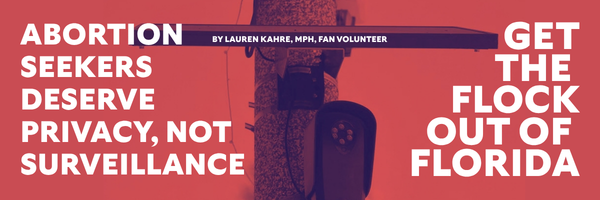
Simultaneously, while more Floridians are accessing care through interstate travel in order to receive abortion medical care outside of the state, automatic license plate reader (ALPR) cameras are being deployed overnight. These cameras photograph vehicle license plates as they pass, logging images and metadata into searchable databases accessible to law enforcement. Specifically troubling are a type of ALPR known as Flock Safety (or Flock). These cameras are specific license plate readers owned by one specific private company that manufactures the new cameras as well as the software networks. Because these cameras are privately owned and operated, there is very little transparency and understanding of how this organization is using or possibly selling our surveillance data. As of the writing of this article, there are 9,879 documented Flock cameras across 331 municipalities in Florida, concentrated in major metro areas including Jacksonville, Miami, Tampa, and Orlando (source). In the context of regional reproductive travel, this surveillance system presents a privacy risk that could lead to criminalizing those who seek abortion care or even those who might be believed to have sought care outside state lines.
How the Technology Works
Flock Safety cameras are solar-powered devices that capture license plate images continuously. When a vehicle passes, the camera photographs the plate, records GPS coordinates, timestamps the moment, and uploads the data to a national database. As of 2025, Flock operates in over 5,000 communities across 49 US states and performs over 20 billion scans of vehicles in the US every month. The system also uses an AI Algorithm to identify vehicle make, model, color, and other details (source).
Law enforcement agencies and municipal governments with access to the system can search the database for specific license plates, allowing them to reconstruct a vehicle's movements over time and across jurisdictions. When data from multiple cameras is combined, the system can reveal travel patterns and identify destinations, including medical facilities. These groups have adopted the technology, citing “public safety benefits”, but civil liberties advocates and privacy researchers have documented significant risks. The system collects data on everyone who passes a camera, not just those suspected of crimes. Data retention periods vary by jurisdiction, and data sharing agreements between law enforcement agencies are often opaque. ICE and CBP have repeatedly used Flock to go after immigrants without warrants (source). Kansas police used them to pursue a man who wrote a critical op-ed about the department (source), while a Colorado police officer wrongfully accused a woman of theft based on a Flock hit and then refused to look at evidence proving her innocence (source). A mother and her children were held at gunpoint because ALPR cameras wrongly flagged their car as stolen (source)
Reproductive Travel and the Risk of Tracking
The connection between reproductive travel and license plate reader data emerged explicitly in May 2025, when a Texas sheriff's deputy searched a data pool of more than 83,000 license plate-scanning cameras made by Flock Safety to locate a woman whose partner alleged she performed a self-administered abortion. Public records confirm the officer did conduct the search. The listed reason for the search was "had an abortion, search for female"(source).
The case reveals how law enforcement can mobilize Flock's surveillance infrastructure in the immediate aftermath of reproductive decisions. The deputy reportedly said he was attempting to locate the woman and her children to "check their welfare," claiming he believed she may have been hurt by her partner. However, the investigation was characterized as a "death investigation of a non-viable fetus." Officers who arrived at the residence treated it as a potential crime scene, placing what the woman's partner described as the frozen fetus in a "small body bag" and contacting the district attorney's office to ask whether the woman could be charged and whether a civil lawsuit against the pharmaceutical company that supplied the pill could be filed (source).
The case demonstrates that Flock data can be weaponized to initiate investigations into reproductive decisions, subjecting people to police scrutiny, interrogation, and the threat of criminal charges; regardless of whether those charges would ultimately hold.
Pro-choice activists expressed concern about the precedent. A person leaving a state where abortion is illegal and traveling to access legal care should not be followed by mass surveillance systems. The case showed that Flock's 83,000-camera network could be accessed immediately to locate individuals based on reproductive suspicions, effectively creating a nationwide network for reproductive surveillance. Jaime Miracle, deputy director of Abortion Forward, testified at a Columbus city council hearing on Flock cameras in August 2026 that "the concern is a person who is leaving a state where abortion is illegal and coming to Columbus to get the abortion care they deserve should not be followed into our city by this dragnet surveillance system that we have" (source).
In Ohio, where abortion is legal following a 2023 constitutional amendment, the concern became explicit policy discussion. The state's annual abortion report showed 20.9% of abortions in 2025 were performed on out-of-state patients- meaning roughly one in five abortion procedures in Ohio were for people traveling from states with restrictive laws. Columbus police pulled out of the national network of Flock data sharing in July 2026, and Mayor Andrew Ginther ordered a halt to statewide sharing of data. However, the city still maintains individual agreements with more than 400 different law enforcement entities in Ohio and across the nation where they continue to share Flock data.
The Texas case and Ohio testimony reveal a significant gap in current policy and legal frameworks: there is no federal prohibition on using Flock data to track people seeking reproductive care. The same surveillance infrastructure being used to locate stolen vehicles and apprehend criminal suspects can be,and has been,used to document interstate travel for abortion access and to initiate criminal investigations based on suspected reproductive decisions.
Disproportionate Deployment
Research has documented that Flock cameras are not deployed uniformly across communities. A study by Christopher Newport University professors published in January found that ALPRs are more highly concentrated in Black communities and high-poverty areas. Researchers found that Flock cameras are found in areas where law enforcement said there is a need for more crime prevention. Black neighborhoods also experience Flock surveillance at nearly four times the rate compared to white neighborhoods (source).
In Tulsa, Oklahoma, police recently expanded the use of Flock cameras after a yearlong test run. When local media compared the camera locations with the city's racial demographics, a troubling pattern emerged: Most of the cameras are concentrated in majority Black and Hispanic neighborhoods, while wealthier, predominantly white areas have few, if any (Source). This pattern of concentration has implications. This creates a loop in which the highest number of alerts are generated in minority neighborhoods, justifying police claims that they are simply targeting high-crime areas. As a result, minority groups have to suffer under more surveillance, face a disproportionate amount of police interactions and are more likely to be wrongly identified or accused due to systems errors. (Qu Chronicle).
The consequences of this disproportionate deployment are measurable and documented. The Electronic Frontier Foundation found more than 3,900 agencies logged more than 12 million Flock searches between December 2024 and October 2025. Hundreds of them were associated with political demonstrations, including the 50501 protests, Hands Off protests, and No Kings protests (Atlanta Black Star), suggesting the system is being used to track protest participation and document the movements of people engaged in political activism.
Perhaps more alarming, The 74 obtained Flock Safety audit logs showing 3,100+ police agencies ran 733,000+ searches on school cameras in one month and Immigration-related searches outnumbered criminal ones 2-to-1 (State of Surveillance). Under the guise of system public safety, this tool is being repurposed for immigration enforcement. As the Trump administration intensified immigration enforcement efforts, growing numbers of cities began reconsidering whether the technology creates the potential for mass surveillance or could aid federal deportation efforts.
Florida ranks third in the United States for total immigration population, behind only California and Texas (source). This makes the state a particular focal point for immigration enforcement efforts. In the past year, Governor Ron DeSantis has approved approximately $4.6 million in requests from local law enforcement agencies for ALPRs in connection with ICE efforts (source). The FDOT order removing Flock cameras from state roads in September 2026 therefore, represents a significant reversal from the state's prior posture of funding ALPR expansion for immigration enforcement purposes. However, the timing and framing of the order reflect broader political calculations. Governor Ron DeSantis, who originally approved the state contract with Flock Safety, has distanced himself from the surveillance infrastructure as opposition to mass surveillance has emerged as a rare bipartisan issue. Flock surveillance has become a central platform for Democratic campaigns, with the technology increasingly recognized as a privacy threat that transcends traditional partisan divides. Recognizing the political liability ahead of elections, the Republican administration moved to end the state's association with the cameras.
This political reversal, however, should not be mistaken for a principled stance on surveillance. Election cycles create windows of accountability, but they are often temporary. Surveillance infrastructure that is removed under political pressure can be reinstated under different political conditions. If the political landscape shifts after the 2026 elections, there is a significant risk that the state could move to reinstate ALPR cameras on state roads, potentially without the limited oversight mechanisms that currently exist. The removal of cameras from state roads, while meaningful, does not address the broader surveillance apparatus that remains on county roads, private property, and in national databases.
The FDOT Order and Its Limits
On September 1, 2026, the Florida Department of Transportation (FDOT) announced it is revoking permits for Flock Safety cameras and other license plate readers installed within state-owned rights of way. Law enforcement agencies have 30 days to remove the affected cameras. Governor Ron DeSantis recently described the spread of the cameras as "out of control" and called for stronger statewide restrictions (sjcitizensjcitizen)
The order prompted responses from several First Coast law enforcement agencies. Jacksonville Sheriff T.K. Waters called the cameras "an enormously valuable investigative tool" but said discontinuing the program was appropriate in light of the state's decision and concerns raised by residents. Putnam County Sheriff Gator DeLoach said his agency would immediately disconnect its 18 cameras. While praising the technology for helping locate missing people and criminal suspects, DeLoach said its development had outpaced the laws and regulations governing its use. The St. Johns County Sheriff's Office says it operates 180 license plate readers countywide. The agency had not publicly addressed its position this week, and it remains unclear how many of its cameras are located along state roads. However, the order applies only to readers located within state rights of way. Cameras installed along county roads or on private property are not automatically affected. This means the majority of the ALPR infrastructure in Florida remains operational and continues collecting data (sjcitizen)
Additionally, historical data collected before the order remains searchable in national databases. The FDOT action prevents future deployment on state roads but does not address data retention, deletion, or audit mechanisms for existing records.
Accountability Gaps
Florida law does not currently require police to delete ALPR data within a specific timeframe, and data retention policies vary by agency. Public records requests can reveal some information about searches and data usage, but comprehensive audit mechanisms are limited. Many agencies have not released detailed information about how the data is accessed, searched, or shared with federal partners. The transparency tools that exist, including DeFlock and Eyes on Flock, volunteer-powered maps tracking camera locations, have emerged because official government maps are often withheld from public view. Law enforcement agencies are often reluctant to publicize the specific locations of where such devices are deployed (Boca Raton Tribune).
What Comes Next
With the FDOT order in place and several law enforcement agencies announcing discontinuation of programs, Florida is in a moment of policy transition. Governor DeSantis has called for statewide restrictions, though specific legislation has not been introduced as of early September 2026.
Nationally, the trend is mixed. Some cities are abandoning Flock programs due to privacy and immigration enforcement concerns. Mass surveillance also presents a dangerous threat, especially at a time of extreme federal aggression towards immigrants, transgender people, Black people and other communities of color, and people exercising their First Amendment rights to fight for freedom, equality, and democracy ACLU of Oregon.
Conclusion
The FDOT order represents a step toward addressing surveillance infrastructure, but it is incomplete. Cameras remain on county roads and private property; historical data persists in searchable databases; and comprehensive audit mechanisms do not exist. More fundamentally, the order does not resolve the core threat: when every movement can be tracked, especially for the purpose of stalking and harassing abortion seekers, privacy becomes a reproductive rights issue.
Reproductive freedom requires more than access to clinics and financial support for care. It requires the ability to seek that care without fear that movements will be documented, searched, and weaponized. Everyone deserves to access care without the threat that their travels could be monitored, their destinations exposed, or their decisions criminalized based on surveillance data collected without their knowledge or consent.
For Florida Access Network and other reproductive justice organizations, the work ahead involves not only removing financial and logistical barriers to care, but also resisting the surveillance infrastructure that threatens the confidentiality and safety of people seeking abortion access. As more Floridians travel out of state for care, and as questions about surveillance governance remain unresolved, ensuring that travel itself does not become a documented liability is essential to the mission of reproductive freedom.
Tool Kit & Resources
Look up your license plate to see if it has been searched through flock cameras: Have I been Flocked?
Look up the Flock cameras in your areas: MyTownView
DeFlock is an open-source, volunteer-powered project for identifying and documenting automated license plate readers. The map is powered by OpenStreetMap. Camera locations come from volunteers and the OpenStreetMap community, not a private company or government agency. To plan routes that void known ALPRs please check out their map as well as their app, DeFlock.me, downloadable for your phone.
Other Sources